

How T-Bill-Backed Stablecoins Buy Time Until AI Grows the Denominator.
NOON · REF. 005 · 2026.11.16 · THE SAME CLOCK

Around the time ground was broken on the transcontinental railroad in 1863, Washington was already busy with a different kind of construction. That year, Congress passed the National Bank Act, allowing federally chartered banks to issue their own notes, provided those notes were backed by federal bonds. The Senate’s official history lists creating a market for Civil War bonds as one of the law’s purposes.
Around the same time, Jay Cooke ran a nationwide sales campaign that moved roughly $500 million of “5-20” bonds the Treasury had been unable to sell, and in 1865 he sold nearly $1 billion in six months. Railroad money flowed in the shape of federal debt as well. The Pacific Railway Act of 1862 financed construction by lending railroad companies sixteen $1,000 federal bonds for every mile of track laid, and up to forty-eight in mountainous terrain.
Plumbing laid to handle war debt became the plumbing of industry once the war was over. In 1870, Cooke began financing the Northern Pacific Railway the same way. It did not end well. When the railroad bonds failed to sell as hoped, his firm closed its doors in 1873, and the shock spread into the Panic of 1873. Still, the sequence was clear. The monetary and financial plumbing the state had rebuilt for its own debt came first. Industry rode on top of it.
Technology analysis has a common blind spot: the assumption that money passively follows innovation. Engineers build the infrastructure, compute clusters train the models, companies launch services, and the financial system simply settles the revenue in the background. Within that frame, stablecoins and tokenized assets easily look like speculative leftovers orbiting the “real” revolution of AI.
The sequence has usually run the other way. There is an older precedent, too. In 1694, the English Parliament granted the Bank of England the privilege of issuing banknotes in exchange for a £1.2 million loan to fund the war against France. This was long before the Industrial Revolution began. It was not a measure to ease trade settlement but a stopgap for carrying state debt. Over time, the credit plumbing built that way hardened into sterling, the standard means of settlement.
The fiber-optic boom of the 1990s shows how the same sequence can go wrong. Finance moved first then as well. The plumbing this time was private credit: vendor financing from telecom equipment makers and a junk bond market that had swollen after deregulation. It paid to lay cable far ahead of actual demand. When demand could not keep pace, bandwidth prices collapsed, leading to a wave of telecom bankruptcies in 2001–2002. Finance arrived first, just as before, but this time the plumbing was laid by private credit rather than the state, and it did not hold.
States have rarely reworked money for the sake of industry. They have usually reworked their monetary plumbing because of their own debt, and the next industry has ridden on the byproduct.
This piece argues that America’s rush to legislate stablecoins sits on the same sequence. More than 160 years ago, the United States had already once tied the collateral of private money to federal bonds. This time, what is being tied down is not banknotes but onchain dollar tokens. This legislation is not a side event riding the AI boom. It targets two national needs at once: creating a new class of buyers for a federal debt that has passed $40 trillion, and laying the payment infrastructure in advance for an economy in which machines, not humans, are the parties to the transaction.
One point needs to be made clear here. The statutory text and figures cited below are facts confirmed against original documents or credible reporting. These include the GENIUS Act’s reserve requirements, Tether’s and Circle’s disclosures, and the analyses and projections of central banks and other institutions.
The Treasury Secretary stated in an official release that stablecoins would increase demand for Treasuries. But no one has said that the Treasury’s debt management, the Fed’s judgments and Congress’s legislation form a single design. Reading those facts as one design is this piece’s interpretation. I return to the grounds for that reading in the conclusion.
The Limits of Traditional Fiat: Why Existing Buyers Alone Struggle to Absorb $40 Trillion
The structural dilemma Washington faces is that the traditional buyers of Treasuries no longer have the capacity they once did. Those buyers are commercial banks, foreign official institutions and domestic pension funds.
After the 2008 financial crisis and the 2023 collapse of Silicon Valley Bank, commercial banks came under the constraints of Basel III capital rules, the Liquidity Coverage Ratio (LCR) and the Supplementary Leverage Ratio (SLR). These balance sheet rules raise the cost for banks of taking on large amounts of Treasuries when rates are volatile.
Foreign demand is not what it was either. According to Carolyn Wilkins of the Bank of England’s Financial Policy Committee, the dollar’s share of disclosed global foreign exchange reserves has fallen from just over 70% around 2000 to about 57% in the first quarter of 2026. Geopolitical fragmentation and sanctions risk on dollar assets have become reasons for central banks to diversify their holdings.
Big Tech hyperscalers, meanwhile, are raising more and more money for unprecedented data center investment. In February 2026, Moody’s pointed out that of the $969 billion in future lease commitments held at the end of 2025 by five companies (Amazon, Meta, Alphabet, Microsoft and Oracle), more than two-thirds, or $662 billion, were data center leases that had not yet commenced and therefore did not appear on their balance sheets.
In its March 2026 Quarterly Review, the Bank for International Settlements (BIS) called this structure, in which hyperscalers build data centers through special purpose vehicles set up with minority stakes and long-term leases, “shadow borrowing,” and noted that the debt is held mainly by private credit funds and institutional investors. On top of that, corporate bond issuance is surging.
According to an analysis released by the Treasury Borrowing Advisory Committee (TBAC) on November 4, capital expenditure across the tech ecosystem is projected to rise from $514 billion in 2025 to about $1 trillion in 2026 and about $1.7 trillion in 2027, while operating cash flow reaches only about $1.078 trillion in 2027. Tech bond issuance to fill that gap is expected to swell from $201 billion in 2025 to $586 billion in 2026 and $735 billion in 2027.
TBAC concluded that “there is no clear evidence to date that tech issuance is crowding out Treasuries or non-tech credit.” This piece puts the weight of that conclusion on “to date.” The moment when sovereign and corporate debt compete for the same pool of investor money has not arrived yet. But the size of the debt that would compete grows every year.
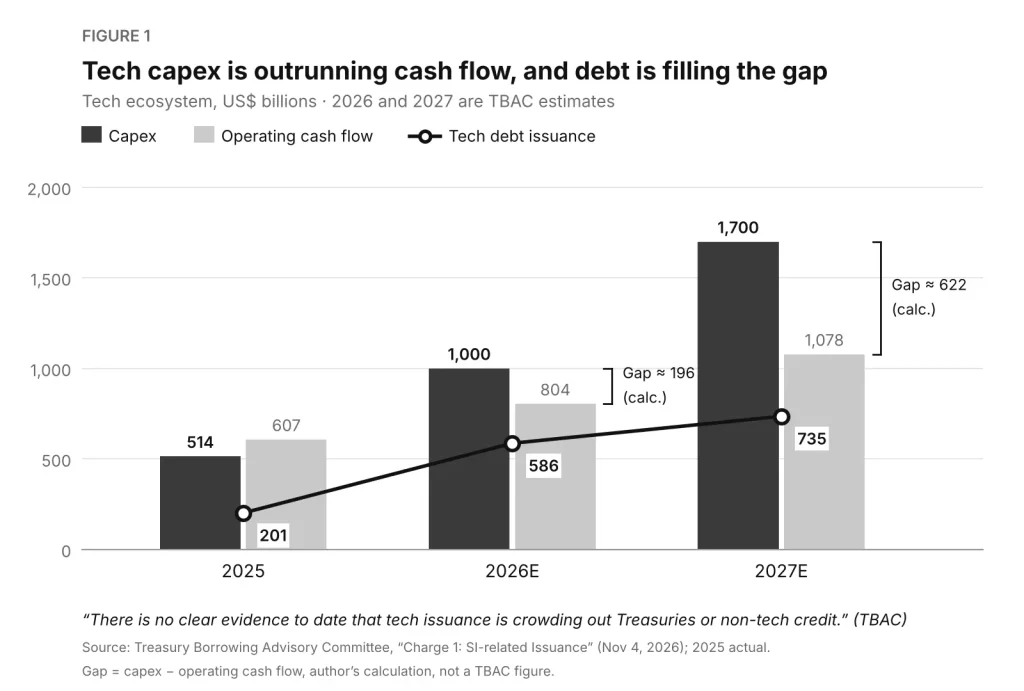
If both streams of debt issuance have to be absorbed through the existing plumbing alone, the burden falls on long-term rates. If the Treasury significantly increases long-term issuance, term premiums on 10- and 30-year bonds rise, and that burden spreads to borrowing costs across the real economy. The solution this piece focuses on, then, is not eliminating the debt but changing its form and its holders: folding short-term sovereign debt into the collateral of digital payment money.
The Institutional Plumbing: The GENIUS Act and Synthetic Demand for T-Bills
The law that actually laid this plumbing is the GENIUS Act. Outwardly, it is a framework for consumer protection and regulatory clarity for payment stablecoins. This piece reads its core function as a demand mechanism that makes private money carry part of the sovereign balance sheet.
Under the GENIUS Act (signed July 18, 2025; Public Law 119-27), every licensed issuer of payment stablecoins must hold reserves backing outstanding issuance at least one to one, and those reserves are narrowly limited to Federal Reserve deposits and cash, insured deposits, U.S. Treasuries with a remaining or original maturity of 93 days or less, overnight repurchase and reverse repurchase agreements, and money market funds holding only such assets. Just as the national bank notes of 1863 used federal bonds as collateral, the collateral of private digital dollars has now been tied by law mainly to short-term Treasuries.
Section 4 of the same law prohibits issuers from paying holders interest or yield solely for holding a stablecoin. This provision changes the nature of the demand. Because issuers pay holders no interest, their funding cost is effectively zero, and they can only deploy that money within the assets the law permits.
Unlike hedge funds or asset managers that constantly weigh the expected returns of risk assets against T-bill rates, issuers have to buy from the same range of assets to meet their reserve requirements whether the 3-month rate is 5% or 2.5%. They are price-insensitive buyers.
That does not mean every dollar that comes in buys a dollar of T-bills. Reserves can also include cash, deposits and repo. According to the Federal Reserve Bank of Kansas City, Circle held only about 43% of its assets in T-bills as of January 2025.
In numbers, the structural impact looks like this:
- The stablecoin market was worth about $300 billion in mid-2026 (Wilkins, September 2026 speech), with roughly 98% of supply pegged to the dollar. Tether’s (USDT) liabilities of about $183.5 billion (September 30, 2026) and Circle’s (USDC) circulation of $73.3 billion (June 30, 2026) add up to about $257 billion, giving the two firms roughly 80% of the market.
- According to Wilkins, the two held about $150 billion of T-bills at the end of 2025, with net purchases of about $33 billion that year alone. That is 2–3% of a roughly $6 trillion bill market. The Bundesbank’s Daniel Fricke compares their Treasury holdings to those of a mid-sized country such as Norway. Compared with money market funds’ T-bill holdings (about $2.5 trillion, roughly 40% of the market), it is still small.
- Future size is a projection, not a settled number. In its April 2025 “Digital Money” presentation, TBAC cited a Standard Chartered estimate that the stablecoin market could grow to $2 trillion by 2028, and assessed that the GENIUS Act’s reserve requirements would be an “additional and growing source of demand” for Treasuries. In a February 2026 update, Standard Chartered kept its $2 trillion forecast but lowered its estimate of new stablecoin-driven T-bill demand from $1.6 trillion (April 2025) to $800 billion–$1 trillion. Adding the Fed’s reserve management purchases and replacement demand for maturing MBS, the bank calculates new T-bill demand of about $2.2 trillion through 2028 against net issuance capacity of only about $1.3 trillion based on Congressional Budget Office estimates, leaving a shortfall of roughly $900 billion. JPMorgan, by contrast, projected in December 2025 a 2028 market size of $500–600 billion. Estimates diverge by as much as a factor of four.
As a single issuer, Tether is the largest. According to a report certified by the accounting firm BDO under the ISAE 3000R standard as of September 30, 2026 (an assurance report at a point in time, not an audit), Tether holds about $191.5 billion in assets against about $183.5 billion in liabilities, mostly tokens issued, leaving an excess of about $8 billion that functions as equity.
Among those assets are about $122.8 billion in T-bills, about $9.5 billion in overnight reverse repos collateralized by Treasuries and about $7.2 billion in term reverse repos, bringing its combined U.S. Treasury exposure across the three to about $139.5 billion.
The Treasury’s own moves point in the same direction. On August 19, 2026, as long-term rates rose, the Treasury raised the size of buybacks in the 10–20 year and 20–30 year buckets from $2 billion to $4 billion or more per operation. When the 10–20 year operation was first enlarged on September 10, the purchase cap was $6 billion. The Treasury did not mention the funding source or any link to bill issuance in its official announcement, but the market expects it to be covered by rising bill issuance. As of September 30, 2026, T-bills made up about 22.4% of marketable Treasury debt, already above the 15–20% range TBAC recommended in November 2020.
The November 4 Quarterly Refunding Announcement (QRA) showed this direction once again. The Treasury held the November refunding ($125 billion) and coupon auction sizes steady while deleting “at least” from its long-standing guidance to maintain them “for at least the next several quarters.”
In the same statement, it said it is monitoring the Fed’s bill purchases and “growing demand for Treasury bills from the private sector,” and that it would temporarily reduce bill auction sizes in December before increasing them “across the bill curve” in January in line with seasonal fiscal outflows. Buyback caps for the next quarter are up to $70 billion for liquidity support and up to $25 billion for cash management (1-month to 2-year bucket). In TBAC minutes released the same day, dealers named stablecoins, alongside money market funds and the Fed, as sources of growing bill demand. Stablecoins had made it into an official Treasury document as a buyer of bills.
What the government expects from this plumbing is not hidden. In his official statement on the day the GENIUS Act was signed, Treasury Secretary Bessent said stablecoins would “lead to a surge in demand for US Treasuries, which back stablecoins,” and “buttress the dollar’s status as the global reserve currency.” Wilkins frames the mechanism as a positive feedback loop: the more dollar stablecoins are used, the wider dollar settlement spreads, the more Treasuries issuers hold, and the deep, liquid dollar market in turn makes dollar stablecoins more attractive. But that loop only applies once the market is large enough. What can be confirmed today is the legal tying of collateral, not payment demand, and as Wilkins adds, the unique premium attached to Treasuries has narrowed considerably of late.
Corporations have their own motive, too. Tokenized Treasuries ease a long-standing compromise in corporate cash management: choosing between earning interest and keeping cash immediately usable. BlackRock’s BUIDL distributes Treasury interest as new tokens every month, and Circle has set up liquidity that lets BUIDL holders exit into USDC at any time. Still, the tokenized Treasury market stood in the $10 billion range as of 2026 reporting, far smaller than the $300 billion stablecoin market. The core plumbing absorbing sovereign debt is still the non-interest-bearing payment stablecoin.
Machine-to-Machine Payments: The Rails Are Laid, the Traffic Has Yet to Arrive
The use case most often cited for stablecoins is payments exchanged between pieces of software: machine-to-machine (M2M) payments. Two questions need to be separated here: why such payments are hard to sustain on card networks, and how much of them has actually arrived.
Cards don’t fit, and not because the amounts are small. Looking at the history of money in three stages shows why. Paper money removed the weight of gold. Bills of exchange, checks, credit cards and bank networks expanded trade to continental scale on the promise of “hand over the goods now, settle the money later.” The price was that settlement was tied to banking hours and batch reconciliation, and the trust in between rested on the repayment capacity of “the person who pays later.” Card payments sit in this second layer. They are credit transactions in which the card network pays the merchant first and bills the consumer later, which is why they come with approval checks, fraud detection and chargebacks.
The third stage, onchain stablecoins, removes this time gap. A token already backed by assets at the moment of the transaction moves across as the final means of settlement in itself. With no room for credit, there is nothing to reverse. The difference lies not in the size of the amount but in the layer of settlement. Cards place a bet on a human’s promise to pay later; stablecoins exchange money that has already been prepaid with assets. For fully autonomous agents that must transact without a human to extend credit to, the first model does not fit.
That does not mean cards have been pushed out of this space entirely. On September 17, 2025, Google released Agent Payments Protocol (AP2), a standard for agent payments covering cards, real-time bank transfers and stablecoins, and connected the stablecoin side through an x402 extension built with Coinbase and others. The card camp moved too. Mastercard launched Agent Pay in April 2025, issuing dedicated tokens to registered and verified agents, and Visa followed in October with its Trusted Agent Protocol, which helps merchants distinguish legitimate agents from malicious bots. Transactions in which a human gives final approval or can step in afterward, such as booking flights or managing subscriptions, run perfectly well on cards. In those cases, a human to extend credit to still stands behind the deal.
Where cards fall behind is fully autonomous transactions with no human to extend credit to, usually in the micro-payment range below a dollar. x402, released by Coinbase and Cloudflare in May 2025, targets this gap. When a server demands payment with an HTTP 402 (“Payment Required”) response, the agent pays instantly in USDC and receives the resource. No account or prior contract is needed.
The problem is that this gap is still small. According to a July 2026 report by Visa and onchain analytics firm Artemis, x402 processed $135.7 million in raw volume from its launch in May 2025 through April 21, 2026, but filtering out apparent self-dealing and test transactions leaves about 109.6 million transactions worth about $15 million. Roughly 90% of the dollar volume was filtered out. Monthly transactions peaked in November 2025 (about 38 million) and fell to 2.1 million in March 2026. McKinsey and Artemis estimate real stablecoin payments at about $390 billion a year based on December 2025 activity, roughly 0.02% of global payments. By comparison (the time frames differ, cumulative versus annual), M2M payments today are a rounding error. Even within real-world payments, the largest share is still not AI but business-to-business (B2B) payments, at about $226 billion, or roughly 60%. The Visa–Artemis report also sees micro-transactions such as API calls as where a new payment structure is most needed, while describing a picture in which cards and stablecoins coexist, each in its own domain.
So what can be confirmed today is not that “agents are already pushing out cards” but that the rails are being laid ahead of the traffic. On April 2, 2026, the Linux Foundation announced the creation of the x402 Foundation. The 22 organizations that pledged support included Visa, Mastercard, American Express, Stripe, Google, Microsoft, AWS and Shopify, and the foundation’s official launch was announced in July. Institutional participation is running ahead, but verified machine payment volume is still small. In the language of this series, this demand is, like software revenue and physical AI cash flow, a value yet to arrive.
The rails themselves are not yet solid either. Onchain payments cannot be reversed, so there is no safety net like a card chargeback. In March 2026, a security advisory (GHSA-qr2g-p6q7-w82m) was issued for a vulnerability in the x402 SDK handling Solana payments, and in a 2026 paper, researchers from EPFL in Switzerland and Zhejiang University tested 15 major facilitators handling about 99% of transactions and reported 31 new vulnerabilities, including replay cases in which a spent payment proof was used again. Onchain records show only that a payment happened, not who paid or why, and who bears legal responsibility for an agent’s payment errors is still unclear.
This lag is not new. There has always been a gap between physical infrastructure and the payment networks that run on top of it, and the way that gap was filled has differed each time.
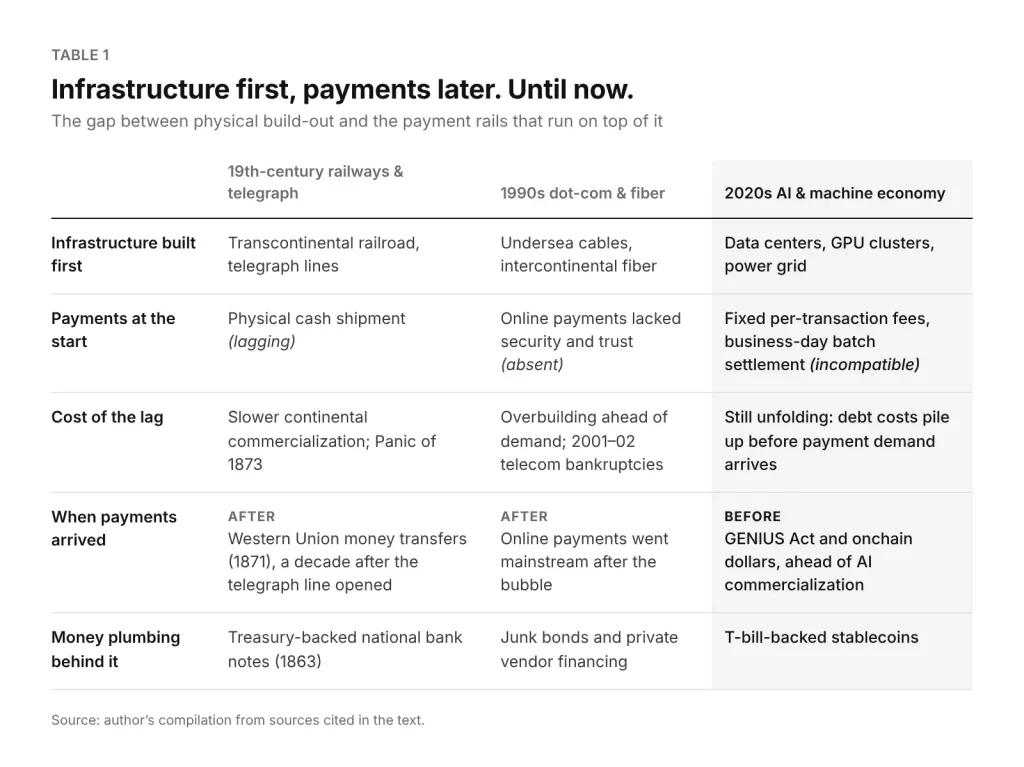
In the previous two cases, payment networks arrived after the industry, usually only after a bubble had burst. This time the order is reversed: payment networks are being laid down by law before the bubble has even fully formed.
Points of Concern: Money Without a Lender of Last Resort
The argument so far rests on the premise that stablecoins work as a stable mechanism for absorbing sovereign debt. But this structure has vulnerabilities that are hard to see in normal times.
First, there is no lender of last resort.
Unlike commercial banks, stablecoin issuers have no lender-of-last-resort backstop such as the Fed’s discount window. The GENIUS Act does not open a path for nonbank issuers to access Fed master accounts. A stablecoin is effectively a demand claim that can face redemption requests around the clock, yet it has no central bank safety net to lean on in a crisis. Looking back at the history of private money in 19th-century Britain and the United States, Wilkins points out that successful private money needed both a mechanism to hold par in normal times and a mechanism to supply liquidity in a crisis. The national bank notes of 1863 had sound Treasury collateral, but with no way to expand the currency in a crisis, the system went through the panics of 1873, 1893 and 1907. What filled that gap was the Federal Reserve in 1913.
How sensitive this gap is can be seen in an estimate from BIS Working Paper No. 1270. The study estimates that a $3.5 billion stablecoin inflow (two standard deviations) lowers 3-month T-bill yields by 0.71 basis points immediately and by up to 4 basis points within ten days. In normal times, the effect is not large. But it is state-dependent: during Treasury General Account (TGA) rebuilds or Treasury market stress, the same $3.5 billion grows to 8–10 basis points, and the effect deepens as the stablecoin sector grows larger and from 2024 onward. The authors warn that because the estimates come from a period of smooth market expansion, they are likely a lower bound for the outflow-side effects of a large-scale redemption event. They also make clear that they do not directly estimate outflows.
Wilkins compared this structure to the feedback loop of the pension fund LDI crisis that shook the U.K. gilt market in the autumn of 2022. If several large issuers had to sell T-bills at once, especially in an already stressed market, it could amplify movements in yields and liquidity. She also said, however, that the sector is not yet large enough to pose a major threat to the Treasury market. The warning is that the same mechanism that supports Treasury demand in normal times could flip in a crisis into one that amplifies selling.
Second, the maturity structure shortens.
Once short-term Treasuries gain a new, price-insensitive buyer, the Treasury has a greater incentive to lean on bill issuance. The T-bill share has already moved beyond TBAC’s recommended range. The higher the share of short-term debt, the more often the sovereign has to refinance, at whatever the rate happens to be. It is a choice that eases pressure on long-term rates at the cost of greater rollover risk. If rates stay higher than expected, interest costs can climb quickly.
Third, bank credit intermediation could shrink.
The GENIUS Act prohibits issuers from paying holders interest, but payment convenience alone could move part of commercial banks’ demand deposits into stablecoins. The Kansas City Fed’s analysis estimates that, if issuers’ current asset mix holds, every dollar of deposits that moves into stablecoins raises economy-wide Treasury holdings by about $0.30 and reduces bank lending by about $0.50. That increased Treasury demand comes at the cost of reduced demand for other assets is, in fact, the title of the report. It means banks’ low-cost funding that once flowed into loans for local small businesses could be repurposed into money that buys short-term sovereign debt.
Fourth, a scenario that has not yet happened: who ultimately receives the Treasury interest?
This is an assumption looking past January 18, but I include it because the facts that can be confirmed today point in that direction.
Start with the facts. Because the GENIUS Act bars issuers from paying interest to holders, the Treasury interest generated by reserves belongs to the issuer. Of Circle’s total revenue of $701 million in the second quarter of 2026, $668 million was reserve income, and most of the $412 million in distribution and transaction costs in the same quarter was paid to distribution partners. A structure in which issuers and distribution networks split Treasury interest is already in operation.
On the other side, tech’s funding shortfall is widening. TBAC wrote that secured financing such as GPU-backed lending is taking a growing share of the funding that fills that gap, and that lenders are demanding “more yield” as well as “more attractive structures.” Rates on data center money that hyperscalers borrow through off-balance-sheet structures or against GPUs are rising from the 6% range to above 7%, at least 2 to 3 percentage points above the short-term Treasury yields that reserves earn.
The assumption starts here. If hyperscalers became distribution partners that share revenue with issuers, or began issuing directly, a structure could emerge in which Treasury interest generated from money taken from users without interest offsets part of data center borrowing costs. The final recipients of that interest would be the private credit and infrastructure investors who lent to data centers and GPUs. If AI monetization is delayed, repayment pressure could pass through to users via API prices and subscription fees. In that case, users would bear a double burden: supporting Treasuries without earning interest on the money side, and sharing the cost of capital expenditure on the service side—a kind of “digital rent.”
This assumption also faces clear barriers. Under the GENIUS Act, a public company whose main business is not financial must obtain unanimous approval from a committee made up of the Treasury Secretary, the Fed Chair and the FDIC Chair to issue a stablecoin, and it may not use transaction data for advertising. In June 2026, the New York Department of Financial Services proposed a rule that would bar such companies from even applying to issue. In practice, Meta chose to pay some creators in Circle’s USDC rather than launch its own coin. The scale doesn’t match either. Even if $100 billion in reserves earned 4% a year, that would be $4 billion annually, small next to the $735 billion in tech bond issuance projected for 2027 alone. So if this scenario becomes reality, its form would be closer to revenue sharing than direct issuance. And that revenue sharing is precisely the issue that stalled the CLARITY Act: who gets to pay rewards for holding stablecoins.
In the end, how fast stablecoins absorb Treasuries and how well that absorption holds up in a crisis are separate questions. The current design solves the supply-and-demand problem of normal times, but it leaves the problem of an emergency liquidity backstop unsolved.
Conclusion: Not Paying It Down, but Growing Past It
This piece does not see the build-out of onchain dollar infrastructure as a crypto speculation cycle or an administration’s improvisation. It sees it as a financial hegemon adapting to its own debt structure. Facing $40 trillion in debt, the United States is choosing not to shrink the debt but to change what the debt is used for. By writing short-term Treasuries into law as the collateral of private digital money, it is making sovereign debt the payment foundation of the coming machine economy.
One point needs to be stated precisely here. There is no documentary evidence that the Treasury, the Fed and Congress actually moved under a single plan. It remains possible that each institution carried out its own mandate and the results simply lined up.
This piece leans toward reading it as an “intended design” because of how well the pieces fit. The maturity limit on reserve assets (93 days or less) overlaps with the bill segment where the Treasury is increasing issuance; the expansion of long-end buybacks came just as the bill share moved past its recommended range; and the law’s effective date coincides with the period when hyperscaler investment is growing fastest. The Treasury explained January’s bill increases with seasonal fiscal outflows, but that January is also the month the GENIUS Act takes effect. At the moment a new, price-insensitive buyer appears by law, the Treasury increases bill supply, buys back long-term bonds and leaves the door to larger coupon auctions slightly open. This piece reads these three not as separate moves but as one sequence. The Treasury Secretary said on the day the law was signed that this plumbing would greatly increase Treasury demand, and in the TBAC minutes, dealers named stablecoins as a buyer of bills.
For a clue to what this design is betting on, look to 19th-century Britain. When the Napoleonic Wars ended in 1815, Britain’s national debt was close to 180% of GDP by the Office for Budget Responsibility’s (OBR) estimate (some studies put it in the 220% range, depending on the GDP estimate). By 1913–14, it had fallen to 29%. Over the same period, nominal debt fell only by about a third, from about £1 billion to £650 million. The OBR attributes the decline to sustained economic growth and the absence of major wars. What drove the ratio down was the denominator the Industrial Revolution expanded: the size of the economy. Britain escaped its debt trap less by paying off its debt than by growing faster than it.
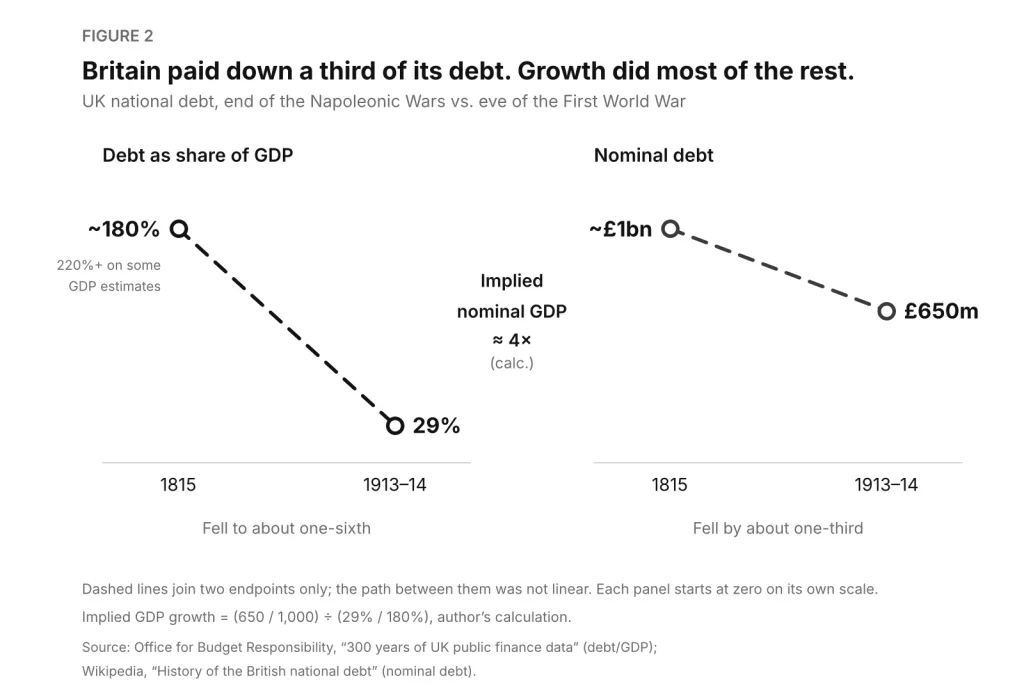
Ventura and Voth go a step further, arguing that Britain’s massive borrowing actually accelerated the Industrial Revolution. Government debt drew aristocratic capital away from low-return old sectors, enlarging the share of labor and profits that went to emerging industries. The aristocrats who bought those bonds, however, missed out on the high returns of the new industries, which contributed to their relative decline. To extend the analogy, what stablecoin holders hold today is likewise an interest-free token backed by government debt, not equity in AI companies. This time, the ones receiving the Treasury interest are likely to be not the users holding the tokens but the issuers, their distribution networks and the lenders who financed the data centers.
This design reads as the same bet. Buy time with stablecoins and short-term Treasuries, and hope AI grows the denominator in the meantime.
The “values yet to arrive” this series has discussed are that denominator: software revenue, physical AI cash flow and the traffic of machine-to-machine payments. Whether that denominator is coming is now also an official item on the central bank’s agenda. On October 28, holding the policy rate at 3.75–4%, Fed Chair Warsh said, “My judgment is we have seen an improvement in productivity; we can’t measure it precisely,” and noted that he had given the task forces, including the one on productivity and employment, a year-end deadline.
The time to be bought is not short, either. According to Wood Mackenzie, the average lead time for power transformers was about 128 weeks as of the second quarter of 2025, and about 143 weeks for generator step-up units. Plumbing can be laid by law in a matter of months, but the denominator it is waiting for arrives at the speed of transformers, transmission lines and factories. And the differences are clear, too. In the words of economists Martin Ellison and Andrew Scott, who analyzed 323 years of U.K. national debt, Britain’s debt before the 20th century was “repaid through financial surpluses.” Nineteenth-century Britain, on the gold standard, paid down debt with peacetime surpluses, shrinking the numerator while it waited for the denominator to grow. Today’s United States runs deficits on both its fiscal and current accounts and keeps increasing its nominal debt, while waiting for the denominator to grow faster than the numerator. As a country that borrows in its own currency, it has more room to maneuver than Britain had under the gold standard. But if growth is delayed, what fills the gap is likely to be inflation and interest rates.
Just as money backed by government bonds was laid down first while the ties of the transcontinental railroad were being driven in 1863, the plumbing through which robots and autonomous agents will move money is already being laid by law, long before they actually start earning it.
Empires rarely pay off their debts. Some have outgrown them.
The question that remains is whether this plumbing can hold until that denominator arrives. If anything is different this time, it is that we are watching the plumbing being laid in real time—and that what runs beneath it is still $40 trillion of debt.
What to Watch Next
- The Fed task forces’ year-end reports. Following a November 16 conference hosted by the Federal Reserve Board and the San Francisco Fed, the productivity and employment task force is preparing its year-end report. Warsh said “some, but not all, of the groups will probably hit their deadline.” This is where it will be decided which of the two clocks discussed in the previous piece moves first: the “Hawk’s Clock,” which watches inflation, or the “Greenspan Clock,” which watches productivity.
- The GENIUS Act takes effect on January 18, 2027. The Office of the Comptroller of the Currency (OCC) issued its final rule on October 21, 2026, more than three months after the statutory deadline (July 18, 2026), stating that the rule and the GENIUS Act take effect on January 18, 2027. The first test is how much of the bills the Treasury adds in January flows into private digital dollar pools, and how much corporations move from bank deposits into onchain dollars. From there, the growth in outstanding supply will show how much time this plumbing can buy, and the velocity of real payment use will show whether the AI denominator is actually arriving in the meantime.
- The February 3, 2027 QRA (with borrowing estimates on February 1). Having deleted “at least,” how much of its $800 billion first-quarter net borrowing will the Treasury absorb through bills, and when will it formalize coupon increases? TBAC recommended concentrating additional issuance in the 2–10 year sector, and under the median dealer forecast, a $2.14 trillion financing gap opens up in fiscal years 2028–29.
- Whether the CLARITY Act comes back. The market structure bill, which passed the House in July 2025, was blocked 49–50 on a Senate cloture vote on September 15, 2026. Senator Tillis’s motion to reconsider keeps it alive, but whether it revives in the remaining session after the midterms is uncertain. Its central dispute, stablecoin rewards, is directly tied to the revenue-sharing scenario discussed above.
References
U.S. government
- Treasury Borrowing Advisory Committee, “Treasury Bills Supply and Demand Dynamics and Issuance Recommendations” (November 2020)
- Treasury Borrowing Advisory Committee, “Digital Money” (April 2025)
- U.S. Congress, “GENIUS Act (S.1582), Public Law 119-27” (July 18, 2025)
- U.S. Department of the Treasury, “Statement from Secretary Scott Bessent on Enactment of the GENIUS Act” (July 18, 2025)
- U.S. Department of the Treasury, “Treasury Announces Increased Sizes of Nominal Long-End Liquidity Support Buybacks” (August 19, 2026)
- U.S. Department of the Treasury, “Monthly Statement of the Public Debt” (September 30, 2026)
- Federal Reserve, “Chairman Warsh’s Press Conference” Preliminary Transcript (October 28, 2026)
- U.S. Department of the Treasury, “Treasury Announces Marketable Borrowing Estimates” (November 2, 2026)
- U.S. Department of the Treasury, “Quarterly Refunding Statement of Assistant Secretary for Financial Markets Hunter McMaster” (November 4, 2026)
- Treasury Borrowing Advisory Committee, “Minutes of the Meeting, November 3, 2026” (November 4, 2026)
- Treasury Borrowing Advisory Committee, “Charge 1: SI-related Issuance” (November 4, 2026)
Central banks and public institutions
- BIS, Ahmed & Aldasoro, “Stablecoins and safe asset prices,” Working Paper No. 1270 (2025, revised 2026)
- Federal Reserve Bank of Kansas City, Jacewitz, “Stablecoins Could Increase Treasury Demand, but Only by Reducing Demand for Other Assets” (August 8, 2025; updated September 22, 2026)
- BIS, “Financing the AI infrastructure boom: on- and off-balance sheet borrowing” (March 16, 2026)
- SUERF, Fricke, “Stablecoins and the U.S. Treasury market: a new but still small investor group,” Policy Brief No. 1431 (April 2026)
- Bank of England, Carolyn Wilkins, “Money and power: lessons from history for stablecoins and US dollar dominance” (September 15, 2026)
- Office for Budget Responsibility, “300 years of UK public finance data”
Research and company disclosures
- Ventura & Voth, “Debt into Growth: How Sovereign Debt Accelerated the First Industrial Revolution” (2016)
- McKinsey, “Stablecoins in payments: What the raw transaction numbers miss” (February 18, 2026)
- CoreWeave, “CoreWeave Closes Landmark $8.5 Billion Financing Facility, Achieving First Investment Grade Rated GPU-backed Financing” (March 30, 2026)
- Visa & Artemis, “Agentic Payments from the Ground Up” (July 2026)
- Tether / BDO, “ISAE 3000R Assurance Report on the Financial Figures and Reserves Report” (as of September 30, 2026)
Press coverage (secondary)
- Google Cloud / TechGoondu, “Google Cloud unveils open protocol to enable secure payments by AI agents” (September 18, 2025)
- Meta / Fortune, “Meta’s $27 billion bet turns AI compute into Wall Street’s hottest new investment” (October 31, 2025)
- JPMorgan / The Block, “JPMorgan stablecoin market projections” (December 2025)
- Standard Chartered / The Block, “Stablecoins could drive $1 trillion in T-bill demand” (February 23, 2026)
- Moody’s Ratings / Fortune, “Moody’s flags $662 billion risk at the heart of the data-center buildout by just 5 companies” (February 25, 2026)
- New York DFS / Yahoo Finance, “New York wants big tech out of stablecoin business” (June 10, 2026)
- Meta / Capacity, “Meta’s $12bn El Paso bond exposes AI debt repricing” (July 24, 2026)
- Bitcoin.com, “Tokenized US Treasuries sector nears $11B” (2026)
- Wikipedia, “Jay Cooke & Company”; “History of the British national debt”
Note: Official disclosures and announcements with institution and date named in the text are omitted. Secondary sources marked “institution / outlet” were verified via press coverage due to paywalls or non-public originals.
Thanks for reading! The facts are based on the sources above. Interpretations and outlooks are my personal opinions and do not constitute investment advice.
Related Analysis