
The Fed’s 2026 Dilemma: Demand Shocks vs. Greenspan-style Productivity Experiments.
NOON · REF. 003 · 2026.9.10 · THE SAME CLOCK

On August 28, 2026, in Wyoming’s Jackson Hole, Fed Chair Kevin Warsh signaled that “there is still work to be done” to curb inflation. Markets interpreted this as a familiar hawkish surprise. The probability of a September rate hike surged while short-term Treasury yields spiked.
Traders were fixated on PCE figures (3.7% over the last 12 months, heating up to 4.1% when narrowed to the last six months) and a potential 25-basis-point adjustment. Just nine days earlier, on August 19, the Treasury had bought back long-term bonds to shorten the debt’s maturity structure, and the White House had declared stablecoin legislation as the reservoir to absorb that liquidity. Yet, that was already old news.
However, the essence of the day’s proceedings went beyond mere rhetoric. Warsh dedicated a significant portion of his speech to artificial intelligence. He described the current era as a “hinge point,” a phrase borrowed from his mentor George Shultz. He characterized AI as a new variable and potentially a new factor of production.

Investment in equipment and intangible assets grew by approximately 9% on the four-quarter basis, the fastest pace since 2021. Warsh noted that over half of this increase stemmed from AI buildout. Yet, he drew a clear line regarding monetary policy. He clarified that these trends are not yet reflected in interest rate decisions.
Whether AI productivity will generate sustained economic growth, when those gains might materialize, or if token usage will complement or replace labor remains a “major line of inquiry.” The hawkish stance and the “unanswered questions” sat side by side in a single speech. These two messages coexisted for a simple reason. For Warsh, they occupied different timelines. Interest rates addressed current inflation. AI optimism targeted future productivity.
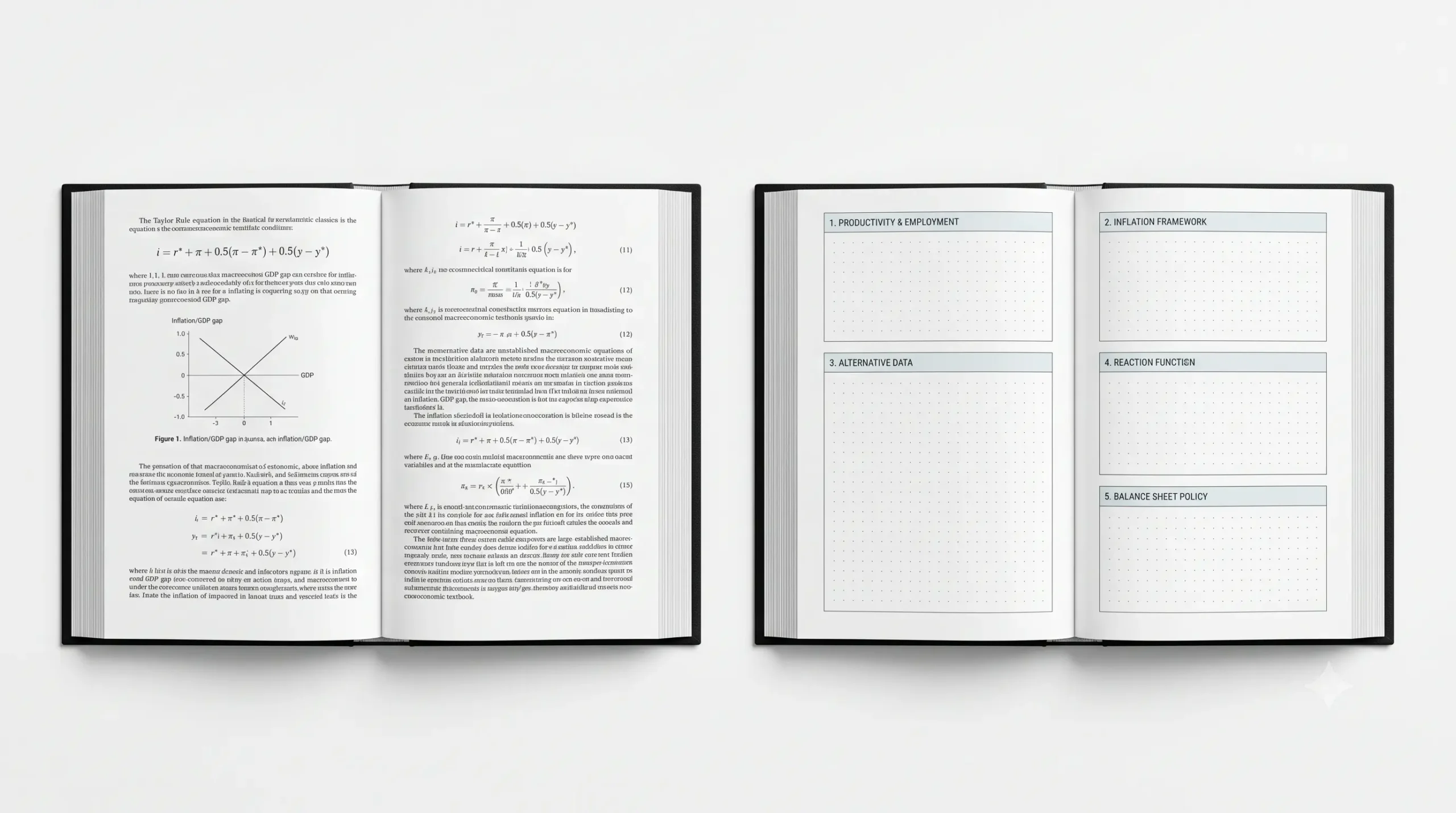
On that day at the Jackson Hole podium, two books were essentially open at once.
Institutionalizing Long-Held Beliefs: From Hoover Critic to Policy Architect
This combination was not accidental. Jackson Hole represented a calculated progression rather than a sudden declaration.
- 2011–2026 (15 years): Following his departure from the Fed Board, Warsh served as a fellow at the Stanford Hoover Institution. He consistently championed the thesis “Inflation Is a Choice.” Drawing on Friedman’s quantity theory of money, he argued that inflation stems from policy choices, such as fiscal deficits and money printing, rather than labor market dynamics. He criticized rigid Phillips Curve trade-offs and the overuse of forward guidance. At the time, this was a minority academic view.
- November 2025: Before his nomination, Warsh wrote in the WSJ that AI would be a significant disinflationary factor. He argued that if productivity rose by 1% annually, standards of living could double within a generation.
- April 2026: During his Senate confirmation hearing, he gave a conditional answer when asked if AI provides an opportunity for rate cuts. He stated it could be the opportunity but noted that certainty was still lacking.
- May–June 2026: Warsh took office as Fed Chair on May 22. In his first press conference, he signaled a break from “cruel choice” dogmas of the Phillips Curve. He argued that growth, low inflation, and high employment could coexist through productivity-led expansion.
- July 2026: The Fed launched five external advisory task forces covering communication, data, balance sheet policy, productivity/employment, and inflation frameworks. Marc Andreessen led the “Productivity and Employment” task force alongside Stanford economist Charles Jones and Xbox CEO Asha Sharma. He created a mechanism to actually verify the hypothesis he had only cautiously entertained during his hearing.
- August 28, 2026: The Jackson Hole speech. Warsh maintained the condition that productivity must be verified before policy shifts.
Warsh did not flip his core beliefs at Jackson Hole. He simply reaffirmed a conditional statement he had held for 15 years: “If AI-driven productivity is actually confirmed, there is room to cut rates.”
The condition that AI-driven productivity must be proven before rates can fall remained unmet according to traditional metrics (Phillips Curve, 12-month/6-month PCE). Simultaneously, he prepared the tools to act once that condition is met: the July task forces. He is reading the final pages of the old book while preparing to turn to the first page of the new one.
Media observers noted that Warsh’s strategy echoes Alan Greenspan’s 1990s approach. However, the methodology differs. Greenspan relied on personal intuition to keep rates low, bypassing the paradox identified by statistician Robert Solow in 1987 that “the computer age is visible everywhere except in productivity statistics.”
Warsh seeks to institutionalize this same paradox not through personal intuition, but by integrating AI alternative data, such as token throughput and data center power contracts, into the Fed’s official econometric models.
The Fed’s communication style has also shifted. The June FOMC statement was shorter than usual. The focus is moving away from forward guidance toward “reaction functions” that define specific conditions for rate adjustments.
“We recognize that AI is a new variable, potentially a new factor of production, that will have consequences for both the economy and the conduct of monetary policy.” Federal Reserve Chair Kevin Warsh, Jackson Hole (August 28, 2026)
Why Not Cut Rates Now?
If AI is expected to drive growth without inflation, why prepare for rate hikes?
The answer lies in the fact that the task force has not yet reached its own conclusions. June FOMC minutes show that while some members acknowledged potential productivity acceleration, they remain uncertain about timing and scale. They warn that these effects may lag behind the demand surge created by AI adoption. To them, the productivity benefit is still an “unrealized expectation.”
Conversely, current visible data points in the opposite direction. New York Fed President John Williams noted that AI-driven power and semiconductor prices are spiking two to three fold like a “hockey stick.” He defined AI as a “demand shock” rather than a supply shock. If supply cannot keep pace with demand, inflation will not subside.
AI has arrived first as a demand shock driving up the costs of data centers, power, and memory chips. The promised supply shock from productivity remains a future commitment that the task force intends to verify by year-end.
Warsh could include both hawkishness and AI optimism in one speech because they exist on different timelines. Kenneth Rogoff of Harvard echoed this sentiment at the Jackson Hole luncheon, arguing that the idea of AI magically solving everything is somewhat exaggerated; if it truly boosts growth, it might actually provide a reason to raise rates rather than lower them.
The market reacted accurately to this dual timeline. Before the speech, the probability of a September pause was nearly 70%. After the speech, the hike probability jumped to 56% and reached 66% by August 31. Figures on Kalshi (48%) and Polymarket (49%) remained inconclusive.
That 66% figure did not last. On September 3, Governor Christopher Waller provided a nuanced view in an interview with Reuters Newsmaker. His message was neither a full endorsement of hikes nor cuts. He stated that if recent disinflationary signals continue for two weeks, he would lean toward a pause. He cited the three-month core inflation trend, which fell from 4.76% in February to 3.05% in July. However, he added a caveat. If August data shows this improvement was temporary, a hike in the September meeting could be appropriate.
Waller did not pivot from hawkish to dovish. Like Warsh, he confirmed a conditional “wait-and-see” approach centered on the August CPI data due on September 11. However, his reliance on three-month trends is a softer interpretation than Warsh’s 12-month/6-month figures (3.7%, 4.1%). The market read this as a “crack in the hawkish camp.”
Notably, Waller agreed with Chair Warsh that forward guidance is currently inappropriate. While they may differ on the direction of rates, they are aligned on moving toward a reaction-function communication model.
There is also a fiscal reason for this delay. The Congressional Budget Office (CBO) estimates that net interest costs for the 2026 fiscal year will reach 19% to 22% of federal revenue, the highest since 1991.
Meanwhile, Moody’s highlighted a private-sector time bomb. The five major hyperscalers Amazon, Meta, Alphabet, Microsoft, and Oracle, have $662 billion in off-balance-sheet data center lease commitments, amounting to 113% of their adjusted debt. These liabilities will appear on the books as leases begin.
Both the government and Big Tech have strong incentives to lower rates immediately. However, doing so carries the risk of being perceived as a surrender to inflation. Warsh uses the strictest hawkish language while simultaneously building the econometric case for future cuts.
Political intervention in fiscal and monetary policy is a structural trend rather than a new phenomenon. The conflict of interest surrounding Warsh’s task force members (noted by some Senators during his hearing) is another example of how specific networks influence policy judgment. Nevertheless, interest rates are set by the full FOMC, which still contains skeptical voices like Rogoff.

What to Watch Next
- August CPI (September 11) & FOMC (September 15–16): Both Warsh and Waller have explicitly tied their policy stances to this data. It is likely to be the deciding factor between a rate hike and a pause.
- Productivity & Employment Task Force Report (Year-End): If the findings lean toward AI-driven productivity gains beginning to show up in the data, a Greenspan-style response becomes possible. If the caution from the June minutes holds, Warsh’s hawkish stance is likely to continue for a while longer.
- September FOMC Minutes: Worth watching for whether the cautious tone from June shifts.
Epilogue: Two Books on the Podium
On that day in Jackson Hole, two books sat side by side. One was an old textbook whose final page had just been turned. The other was a new volume with many blank pages remaining.
Which of the two clocks strikes first will determine the next phase of this balance.
Appendix: Completing the Scale
This analysis builds upon the variables established in the two earlier pieces. If AI infrastructure debt is the scale, then software revenue C_{sw}, physical AI cash flow C_{phy}, financial market liquidity \Phi_{fin}, and government intervention G form the counterweight.
\frac{dD}{dt} = rD + I - \left[ C_{sw}(t) + C_{phy}(t) + \Phi_{fin}(t) + G(t, \pi) \right]C_{sw} : Software sales
C_{phy} : Physical AI surplus cash flow
\Phi_{fin} : Financial market liquidity
[Equation 1] Macro Debt Dynamics Model. This is a conceptual illustration, not a tool for literal numerical calculation — it shows the interplay between debt and the factors that counterbalance it.
The previous analysis (“Same Day, Different Stage: Liquidity Was Already Shifting Course”) showed how G and \Phi_{fin} intertwined in a single day on August 19 through the GENIUS framework. One term on this scale has historically been treated purely as a market-determined discount rate: r.
The Jackson Hole speech reveals that r is no longer determined solely by pure market data. It now depends on both time t and an additional variable, \mu. In other words, r can now be expressed as r = r (t, \mu)
Here, \mu represents the institutional judgment of whether the Fed views AI as a “demand shock” or a “supply shock”, reflecting the direction of belief Warsh is institutionalizing through his task forces. This \mu shares characteristics with the political will \pi defined in part 1.
It is impossible to verify ex-post, non-reproducible, and creates false precision once quantified. While \pi represented the political will of the White House and Treasury, \mu is a more restrained version of the same phenomenon occurring within an independent institution.
Three of the four terms on the scale (G, \Phi_{fin}, and r ) have become variables influenced by political or institutional judgment.
Only C_{sw} and C_{phy} remain verifiable by pure market data, and coincidentally, these are the exact values the task force aims to uncover by year-end.
Thank you for reading. The facts are based on the sources below; interpretations and outlooks are my personal opinions and do not constitute investment advice.
References
- Federal Reserve, “Speech by Chair Warsh” Official Transcript (August 28, 2026)
- Federal Reserve, Governor Waller, “The Economic Outlook and Some Comments on My Policy Communication” (September 3, 2026)
- Hoover Institution, “Inflation Is A Choice: Kevin Warsh On Fixing The Federal Reserve”
- CNBC, “Kevin Warsh names members of his Federal Reserve task forces, including Marc Andreessen, Doug McMillon” (July 9, 2026)
- CNBC, “New Fed task force members share Chairman Kevin Warsh’s embrace of AI” (July 10, 2026)
- CNN Business, “Kevin Warsh has little to say about interest rates. But he has plenty to say about AI” (August 2026)
- U.S. Senate Committee on Banking, Housing, and Urban Affairs, “Nomination Hearing” Official Hearing Page (April 21, 2026, Kevin Warsh Nomination Hearing)
- Reuters, “Five things learned at Fed nominee Warsh’s Senate hearing” (April 21, 2026)
- Moody’s Ratings / Fortune, “Moody’s flags $662 billion risk at the heart of the data-center buildout by just 5 companies” (February 25, 2026)
- Peter G. Peterson Foundation, “Interest Costs on the National Debt Are Reaching All-Time Highs” (February 12, 2026, CBO Basis)
- CME Group, FedWatch Tool / Forbes, “CME FedWatch Provides A 66% Chance Fed Will Hike Rates In September” (August 31, 2026)
Thanks for reading! The facts are based on the sources above. Interpretations and outlooks are my personal opinions and do not constitute investment advice.