

Why Bessent Bought Back Treasuries and Trump Embraced Crypto: Connecting the Dots Between Buybacks, the CLARITY Act, and Stablecoins.
NOON · REF. 002 · 2026.8.28 · THE SAME CLOCK

(Image generated with AI)
On August 19, 2026, Treasury Secretary Scott Bessent announced plans to double the scale of long-term Treasury bond buybacks. On that same day, President Donald Trump convened CEOs from digital asset firms in the Roosevelt Room of the White House to urge the swift passage of stablecoin legislation. Bessent continued his remarks on the Treasury market in a separate briefing the following day, August 20.
Neither move was breaking news on its own. Treasury buybacks are a standard technical tool frequently employed by the Department of the Treasury, and calls for stablecoin legislation have been part of the political repertoire for months. Viewed separately, they are merely individual policy updates for the day.
However, viewed side-by-side, a different picture emerges. One was an action to alter the maturity structure of the Treasury market; the other was an action to open a new destination for the reshuffled Treasury supply to flow into. It may have been a coincidental overlap, or it may not. Regardless, the two statements pointed toward a singular, precise direction.
In the previous piece, I modeled AI infrastructure debt as a scale. On one side sits the debt accumulating from interest costs and new investment. On the other are the offsets: software sales, physical AI cash flow, financial market liquidity, and government intervention.
The problem was that the first two were values yet to arrive, while the latter two were dictated by policy decisions rather than market data. Among these, government intervention is an unpredictable variable governed by the political will of policymakers, not a value verifiable through economic data after the fact. To understand the overlap on August 19, we must first trace how this intervention has evolved over time.
This intervention did not appear overnight; it has accumulated over several years, shifting forms along the way. That flow remained uninterrupted even as administrations changed:
- Support: Initially, it was limited to supporting industries through legislation and subsidies. The CHIPS Act allocated massive subsidies, and loan guarantees were issued for nuclear reactor restarts — decisions finalized by the previous administration but executed by the current one.
- Mobilization: The next stage moved toward mobilizing national assets themselves. Immediately following the new administration’s inauguration, an executive order directed the establishment of a sovereign wealth fund, and 16 parcels of federal land were designated as candidates for data center sites.
- Ownership: In the summer of 2025, the nature of the intervention shifted once more: the government began directly holding corporate equity. A 9.9% stake in a semiconductor firm moved into government ownership, and a condition was attached where 15% of revenue from AI chips authorized for export to China would revert to the national treasury.
From support to mobilization, and from mobilization to ownership — the intervention deepened by one stage at a time, regardless of the administration. Under the current administration, however, that intervention has taken on an even more overt form: moving from conditional support (loans and subsidies) to direct ownership (equity and revenue shares).
The two statements on August 19 were the next steps in this trajectory. This time, it was not about owning something directly. It was about laying the financial plumbing for capital flows.
Bessent: Why Buy Back Long-Term Bonds?
On that day, the Treasury announced it would more than double the scale of 10-to-30-year Treasury buybacks from a minimum of $2 billion to $4 billion per round. Just before the announcement, the 30-year yield had spiked to its highest level since 2007. In a CNBC interview the next day, Bessent noted that the scale could exceed $4 billion, stating that “current yields do not properly reflect fundamentals.”
The backdrop of this intervention includes concerns over expanding fiscal deficits, inflation exceeding targets, and large-scale corporate bond issuances competing with Treasuries. Among these, the fastest-growing structural item is corporate debt from AI hyperscalers. Combined annual corporate bond issuance from the top five hyperscalers is already projected at $140 billion, with some projections suggesting that new global AI-related corporate bond issuances could hit $570 billion in 2026 alone.
The core issue is where this buyback draws its funds. The resources for purchasing long-term bonds are ultimately funded by increasing the issuance of short-term Treasuries. This is a move to shift the duration risk of long-term debt toward the short end of the curve.
What Bessent did was not create new money from thin air. Instead, it was closer to the government absorbing illiquid, frozen long-term bonds and injecting liquid, short-term capital in their place.
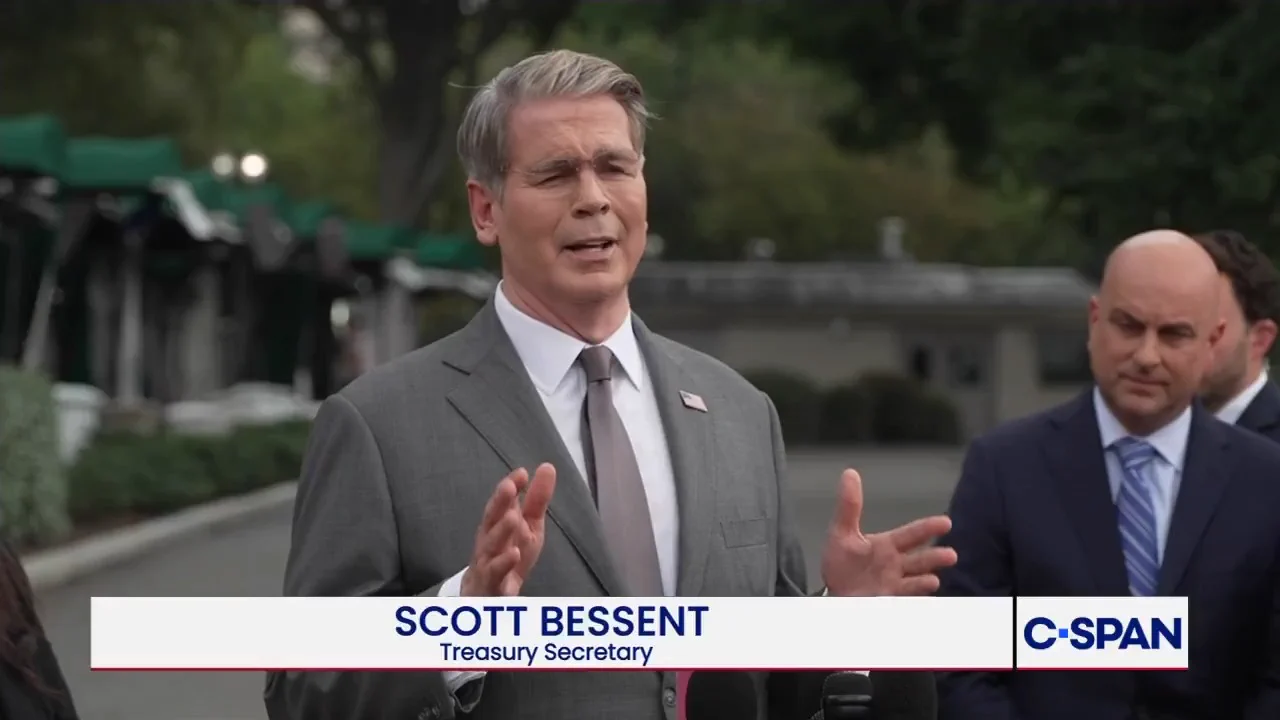
On August 20, the day after the buyback announcement, when asked about total federal debt exceeding $40 trillion, Bessent remarked that “it didn’t happen overnight,” pointing to the previous administration’s fiscal deficits. Setting aside political finger-pointing, this statement illustrates the sheer scale of debt that the Treasury’s buyback measures from the previous day were addressing.
Trump: Where Is That Capital Heading?
If Bessent cleared the path for the water, Trump widened the reservoir toward which it would flow.
On the same day in the Roosevelt Room, Trump gathered CEOs from major digital asset firms including Coinbase, Ripple, Robinhood, and Kraken, along with heads of the SEC and CFTC. The agenda was the swift passage of the CLARITY Act (Digital Asset Market Structure Act) currently pending in the Senate. Trump described this bill as “powerful structural legislation that will allow us to stay ahead of all competitors, including China.”

When reporters asked at the same meeting if the government planned to further accumulate Bitcoin or other cryptocurrencies, Trump responded that there was an intent to do so. While it was an impromptu Q&A, the direction of this remark was no different from the earlier push for the CLARITY Act: a move to incorporate digital assets into the sovereign balance sheet.
The intersection of this remark with the Treasury market lies in the GENIUS Act. Although this law was enacted in July 2025, its effective date is January 18, 2027. Once in effect, stablecoin issuers must hold the majority of their reserve assets in short-term Treasuries with a remaining maturity of 93 days or less.
Currently, we are in a grace period where detailed regulations are being refined; the push for the CLARITY Act and crypto accumulation remarks represent moves to solidify the institutional framework during this window. As the implementation date approaches and the stablecoin market grows, a structure is already in place where automatic, price-inelastic demand for short-term Treasuries will inherently expand.
The current market capitalization of stablecoins is approximately $270 billion to $310 billion. While this represents only about 2% of the entire $6.2 trillion short-term Treasury market, it has grown more than tenfold from $24 billion six years ago. By January 2027, when the law fully takes effect — and as major firms like PayPal and Stripe enter with licenses — estimates suggest it could absorb up to 26% of circulating short-term Treasuries depending on growth scenarios.
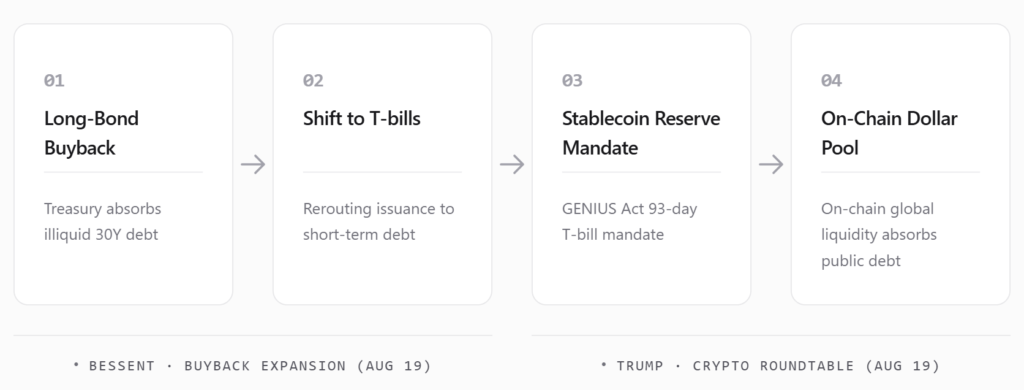
Each was reported as a separate policy news item, but linked together, they form a single pipeline. Until now, the capital flowing into U.S. Treasuries has mostly passed through institutions based on fiat currency — central banks, pension funds, and commercial banks. Stablecoins represent a different kind of buyer: they create Treasury demand in the form of digital currency rather than fiat.
What Is Expanding?
The critical point here is not just the direction. In the previous piece, I identified financial market liquidity as one of the factors supporting debt. The two remarks on August 19 were measures to expand the scale of this specific item.
It is not merely that another type of capital is able to flow into Treasuries; it is that a new stream of demand — one that did not exist in fiat currency — is being created as digital currency.
This type of liquidity tends to leave little trace on the Treasury market when its scale is small, but once it crosses a certain threshold, its influence grows non-linearly. If the stablecoin market grows tenfold from its current size, this liquidity could expand at a rate far exceeding arithmetic progression. At the end of the pipes laid by the two remarks on August 19, there may be a digital dollar reservoir of that magnitude waiting.
What to Watch Next
Shifting the direction is different from arriving safely at the destination. There are several checkpoints to monitor following August 19:
- Interest Rates: The 30-year yield, which plummeted immediately after the announcement, erased most of its drop in a single day. It remains to be seen whether this buyback will end as a one-time psychological play or if it can continue to cap the upper bound of long-term rates.
- November 2026 (QRA & Schedule): The Treasury will release its Quarterly Refunding Announcement (QRA) on November 2 and the specific buyback schedule on November 4. Observing how much the proportion of short-term Treasury issuance actually increases will reveal whether the directional shift on August 19 was mere rhetoric or a substantive shift.
- January 2027 (Regulatory Deadlines): While the effective date of the GENIUS Act is set, regulators have already exceeded the deadlines for establishing detailed rules. The speed at which corporations enter this market will depend on how these regulations are finalized in the remaining time.
- The CLARITY Act: This remains a separate variable. Even if it fails to pass the Senate, the short-term Treasury purchase structure of the GENIUS Act remains operational. However, whether the CLARITY Act passes may dictate the speed at which on-chain liquidity flows into this stream.
The conclusion of the previous piece was that government intervention has physical and fiscal limits. The two remarks on August 19 were the first scenes showing through which pipes that time is being bought. Whether a new scale of liquidity reservoir is actually created at the end of those pipes can only be determined by observing November and January 2027.
How Does This Read Through the Macro Debt Model?
This piece builds directly upon the variables defined in the previous analysis. When modeling AI infrastructure debt as a dynamic scale:
\frac{dD}{dt} = rD + I - \left[ C_{sw}(t) + C_{phy}(t) + \Phi_{fin}(t) + G(t, \pi) \right]C_{sw} : Software sales
C_{phy} : Physical AI surplus cash flow
\Phi_{fin} : Financial market liquidity
[Equation 1] Macro Debt Dynamics Model. This is a conceptual illustration, not a tool for literal numerical calculation — it shows the interplay between debt and the factors that counterbalance it.
Placing the two remarks of August 19 into this framework yields the following interpretation:
Bessent’s buyback is a form of G (Government Intervention):
- However, this specific intervention was not an act of injecting new funds; it was a reallocation — absorbing frozen long-term bonds and filling their place with short-term Treasuries.
Trump’s push targets \Phi_{fin} (Financial Market Liquidity):
- The push for the CLARITY Act and crypto accumulation remarks directly affect liquidity. This is because the 93-day Treasury mandate of the GENIUS Act creates a new form of digital currency demand within the Treasury market.
The significance of combining these two items is that G is creating institutional conditions to expand the size of \Phi_{fin} itself. The structure in which government intervention expands a separate variable like financial liquidity is an interaction not explicitly covered in the scale model of the previous piece.
C_{sw} and C_{phy} — software sales and physical AI cash flow — remain as values yet to arrive in this picture. While the two remarks of August 19 buy time, the ultimate result of the scale will be determined by how much these two values actually arrive.
References
- [Federal Register] Executive Order 14196: A Plan for Establishing a United States Sovereign Wealth Fund (Feb 3, 2025)
- [Intel Newsroom] Intel and Trump Administration Reach Historic Agreement to Accelerate American Technology and Manufacturing Leadership (Aug 22, 2025)
- [CNBC] Treasury Announces Upscaled Buyback Operation for Longer-Term Debt, Sending Yields Lower (Aug 19, 2026)
- [Reuters / Kitco] US Treasury Secretary Bessent Doubles US Long-Bond Buybacks in the Face of Surging Yields (Aug 19, 2026)
- [MarketWatch / Morningstar] Treasury Rout Restarts One Day After Bessent’s Beefed-Up Buyback Plan (Aug 20, 2026)
- [Bloomberg] Crypto Executives Join Trump in Push for US Digital Asset Legislation (Aug 19, 2026)
- [Congress.gov] S.1582 — GENIUS Act: Payment Stablecoin Reserve Requirements & T-Bill Framework (119th Congress)
- [Aspen Institute ESG] Stablecoins After GENIUS: Private Money, Public Debt, and the Global Dollar (2026)
- [Forbes] Bond Investors Push Back As AI Debt Heads Toward $570 Billion (Jul 17, 2026)
Thanks for reading! The facts are based on the sources above. Interpretations and outlooks are my personal opinions and do not constitute investment advice.